
Invisalign attachments are small, tooth-colored shapes bonded to specific teeth that help clear aligners grip the surface of the tooth. These attachments allow aligners to apply more precise pressure, making it easier to rotate teeth, move them vertically, and correct complex alignment issues. They improve the accuracy and efficiency of Invisalign treatment by giving aligners better control during tooth movement.
If you have been told that Invisalign attachments will be part of your treatment, you might be wondering why they are necessary. Many patients expect smooth, nearly invisible trays to do all the work. In reality, small tooth-colored attachments give aligners the extra control they need to move teeth more accurately. These clear aligner attachments act as anchor points that help guide teeth into better positions. In this article, you will learn how these small additions increase precision, improve results, and expand what clear aligners can accomplish.
How Invisalign Attachments Work With Clear Aligners
Clear aligners apply steady pressure to shift teeth gradually. On their own, trays rely on surface contact to create movement. That works well for simple alignment, but more complex movements require added control. Attachments are bonded to specific teeth to give the aligner a better grip and direct force more precisely.
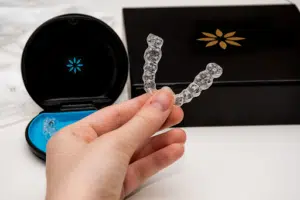
There are several ways these small additions improve movement:
- They help rotate rounded teeth that would otherwise slip inside the tray.
- They support vertical movements, such as lifting or lowering a tooth.
- They improve root positioning for stronger, more stable alignment.
Understanding how Invisalign attachments work helps patients see why aligners can now treat more advanced bite and spacing concerns. By giving the tray defined contact points, orthodontists can plan movements with greater accuracy and predictability.
Why Small Aligners Need Extra Support for Complex Movements
Clear aligners are designed to fit snugly over your teeth and apply controlled pressure. For mild crowding or spacing, that pressure alone can be enough. But teeth do not only move side to side. They rotate, shift vertically, and adjust at the root level. Those movements require more than a smooth plastic surface.
Some tooth movements that often need extra support include:
- Rotating rounded teeth like canines and premolars
- Closing extraction spaces
- Correcting deep bites or open bites
- Moving teeth up or down within the bone
Without added grip, aligners can lose efficiency during these types of movements. Attachments provide defined contact points so the force from each tray is directed exactly where it is needed. That added control can reduce refinements and improve overall treatment accuracy.
Invisalign Attachments for Clear Aligners vs. Traditional Brackets
At first glance, attachments may look similar to small braces. They are bonded to the tooth surface and help guide movement. The difference is that they work with removable trays instead of wires and brackets. Their purpose is not to replace braces, but to enhance how aligners apply force.
Traditional braces, brackets, and wires create constant tension across the teeth. Invisalign attachments for clear aligners serve a different role. They give the tray specific edges and angles to push against, so planned movements happen more accurately. This allows orthodontists to treat cases that once required full braces.
Another key difference is appearance and flexibility. Attachments are tooth-colored and blend in more than metal brackets. They are also removed once treatment is complete. This gives patients a discreet option while still maintaining the mechanical precision needed for predictable results.
What Patients Should Know About Invisalign Buttons on Teeth
When people hear the phrase Invisalign buttons on teeth, they often imagine something large or uncomfortable. In reality, these buttons are small, tooth-colored shapes that are carefully bonded to specific areas of the tooth. Their placement is planned using digital scans and treatment software to match the exact movements needed.
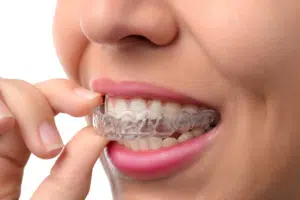
Here is what most patients can expect during treatment:
- Placement is quick and done in the office using a bonding material similar to
- what is used for braces.
- Mild pressure may be felt when inserting or removing aligners at first.
- Eating and brushing continue as normal since aligners are removable.
- Removal at the end of treatment is simple and does not damage the enamel.
These buttons may feel noticeable during the first few days, but most patients adjust quickly. Their presence makes aligner therapy more effective, especially when correcting rotation, bite issues, or vertical movement that trays alone would struggle to control.
Frequently Asked Questions About Invisalign Attachments
Do attachments make aligners more visible?
Attachments are tooth-colored and designed to blend with natural enamel. Most people will not notice them unless they are looking closely.
Can attachments fall off during treatment?
It is possible, but not common. If one comes off, your orthodontist can quickly replace it to keep treatment on track.
Are attachments used for every Invisalign case?
Not every case requires them. They are placed only when specific tooth movements need extra control.
Do attachments stain over time?
They can pick up slight discoloration from coffee or other dark beverages. Good brushing habits and routine visits help keep them looking clean throughout treatment.
Do Invisalign attachments hurt after they are placed?
No. The placement process is quick and painless. You may feel slight pressure when wearing or removing aligners for the first few days.
How long do Invisalign attachments stay on your teeth?
Attachments usually stay on your teeth for the length of your Invisalign treatment. Your orthodontist removes them easily once treatment is complete.
Get to Know the Lasley Orthodontics Team in Renton, WA
At Lasley Orthodontics, we provide high-quality orthodontic care for children, teens, and adults throughout Renton and neighboring communities
Dr. Andrew Lasley is a top-rated orthodontist and premier Invisalign provider who focuses on individualized treatment planning. We take the time to treat each patient as a person, not a number, and we use modern techniques to improve both comfort and precision during aligner treatment. Our office offers Invisalign, metal braces, clear braces, and other advanced options designed to address alignment, bite concerns, and overall smile health. We believe every patient deserves thoughtful care and clear communication throughout treatment.
If you are considering clear aligners and want to learn how attachments can improve your results, schedule a complimentary exam with our team in Renton today.